


-- A growing body of industry data shows that website load speed directly impacts conversion rates, bounce rates, and ultimately revenue for small and mid-sized businesses. Star Diamond SEO, a search engine optimization firm based in northeast Indiana, is urging business owners to treat site performance as a financial metric rather than a technical afterthought.
"Most business owners look at traffic numbers and wonder why sales aren't growing," said Ryan Atkinson, founder of Star Diamond SEO. "They never open the hood. Their site loads in five or six seconds and half their visitors leave before the page finishes rendering. That's not a marketing problem. That's a leaking bucket, and the leak is measurable."
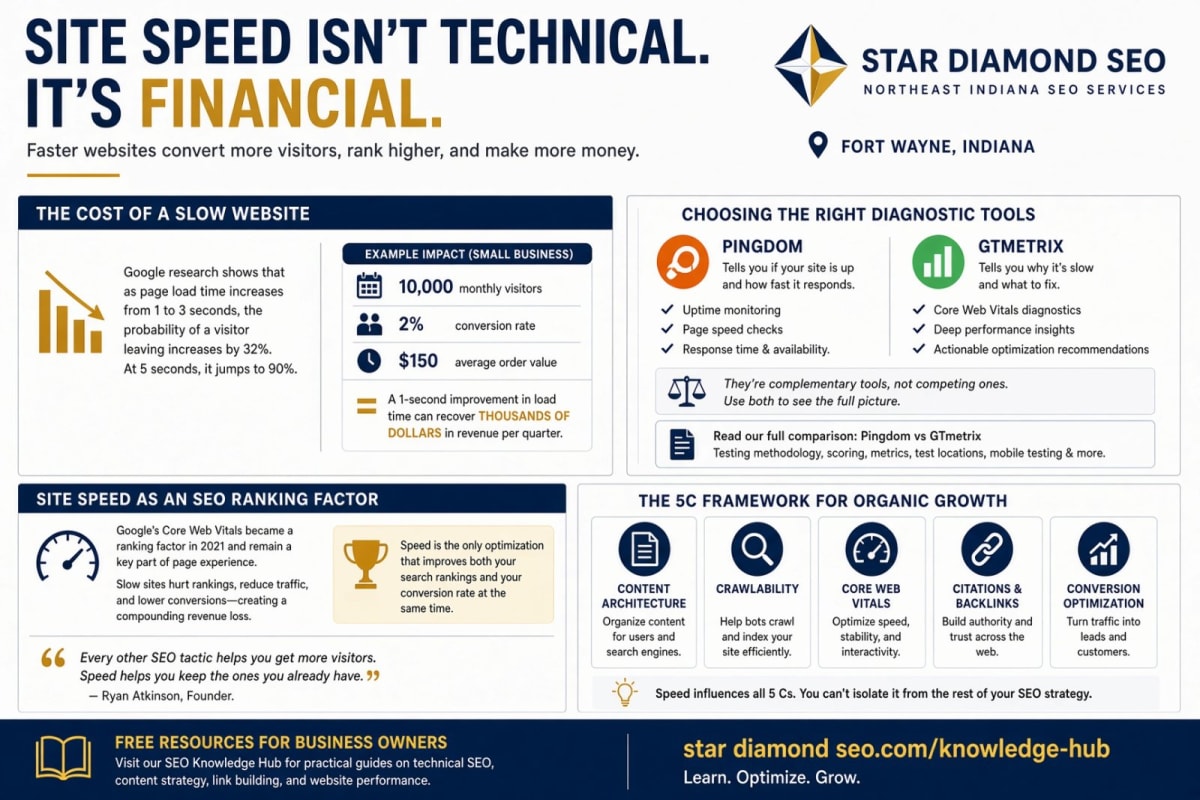 Site speed is a revenue problem, not just a technical one. This breakdown covers the cost of slow load times, when to use Pingdom vs GTmetrix, and how the 5C Framework connects performance to rankings and conversions.
The Cost of a Slow Website
Research from Google has consistently shown that as page load time increases from one second to three seconds, the probability of a visitor leaving the site increases by 32 percent. At five seconds, that probability jumps to 90 percent. For a small business generating 10,000 monthly visitors with a 2 percent conversion rate and an average order value of $150, a one-second improvement in load time can translate to thousands of dollars in recovered revenue per quarter.
Despite these numbers, most small business owners have never tested their website's performance using dedicated diagnostic tools. Many assume that if a site loads on their own device, it loads acceptably for everyone. In practice, load times vary significantly based on geography, device type, network conditions, and hosting infrastructure.
Choosing the Right Diagnostic Tools
Two of the most widely used website performance testing platforms are Pingdom, a SolarWinds product focused on uptime monitoring and page speed checks, and GTmetrix, a tool built on Google Lighthouse that provides deeper diagnostic data on Core Web Vitals and rendering performance. Both tools are free to use at a basic level, and both produce actionable reports that identify what is slowing a website down.
However, the two platforms measure different things and serve different purposes, which creates confusion for business owners who run both tests and get conflicting results.
"We published a detailed Pingdom vs GTmetrix comparison specifically because we kept seeing clients confused by the difference," Atkinson said. "Pingdom tells you if your site is up and how fast it responds. GTmetrix tells you why it's slow and what to fix. They're complementary tools, not competing ones. But if you only run one and ignore the other, you're seeing half the picture."
The comparison breaks down the differences in testing methodology, scoring systems, available test locations, mobile testing capabilities, and the specific metrics each platform reports. It also covers how to interpret waterfall charts, which visualize the loading sequence of every resource on a page and help identify bottlenecks like uncompressed images, render-blocking scripts, and slow third-party requests.
Site Speed as an SEO Ranking Factor
Beyond direct revenue impact, website speed is also a confirmed ranking factor in Google's search algorithm. Google's Core Web Vitals, a set of three performance metrics measuring loading speed, visual stability, and interactivity, became a ranking signal in 2021 and have remained part of Google's page experience evaluation since.
For businesses that rely on organic search traffic to drive leads and sales, a slow website creates a compounding problem. Poor performance reduces the site's ability to rank for target keywords, which reduces traffic, which reduces revenue. Fixing the performance issue addresses both the ranking problem and the conversion problem simultaneously.
"Speed is the only optimization that improves both your search rankings and your conversion rate at the same time," Atkinson said. "Every other SEO tactic helps you get more visitors. Speed helps you keep the ones you already have."
A Structured Approach to Website Performance
Star Diamond SEO incorporates site speed analysis into its broader SEO audit process through what the firm calls the 5C Framework for Organic Growth. The framework covers five interconnected pillars: Content Architecture, Crawlability, Core Web Vitals, Citations and Backlinks, and Conversion Optimization. Website performance falls under the Core Web Vitals pillar but influences all five.
A slow site impacts crawlability because search engine bots allocate a limited crawl budget to each domain. If pages load slowly, fewer pages get crawled per session, which delays indexation of new content. It impacts content architecture because internal links between slow pages create friction that reduces the depth of user sessions. And it impacts conversions because even well-optimized landing pages lose effectiveness when users abandon them before the content fully loads.
"You can't isolate speed from the rest of your SEO strategy," Atkinson said. "A fast site with no content architecture still won't rank. But a well-structured site that loads slowly is leaving money and rankings on the table every day."
Free Resources for Business Owners
Star Diamond SEO publishes free educational resources through its website, including a comprehensive SEO Knowledge Hub covering technical optimization, content strategy, and link building fundamentals. The site speed comparison guide is part of a broader content cluster focused on helping business owners understand and improve their website's technical performance without needing a developer on staff.
About Star Diamond SEO
Star Diamond SEO is a search engine optimization firm based in Fort Wayne, Indiana, founded by Ryan Atkinson. The firm provides content strategy, technical SEO audits, link building, and organic growth management for small and mid-sized businesses using the 5C Framework for Organic Growth. More information is available at www.stardiamondseo.com.
Contact:
Ryan Atkinson
Founder, Star Diamond SEO
Contact Info:
Name: Ryan Atkinson
Email: Send Email
Organization: Search News Now
Website: https://www.stardiamondseo.com
Release ID: 89200767

 Google
 RSS
RSS