


-- On October 31, the 2026 Yangming Philosophy Conference was held in Yuyao, Ningbo, under the theme “Upholding Tradition and Cultivating Innate Moral Knowledge: Putting Knowledge into Practice Across China — Contemporary Applications of Yangming Philosophy Through the Lens of the ‘Two Integrations’.”
More than 500 years ago, Wang Yangming introduced three central ideas: “the mind is principle”, “the unity of knowledge and action” and “extending innate moral knowledge”. Today, these teachings offer valuable insights as the world undergoes rapid change and cross-cultural exchanges intensify.
Preserving cultural heritage requires passing it on and putting it into practice. At the conference, participants shared proposals for applying Yangming philosophy today, exploring ways to preserve China’s traditional culture while advancing its creative transformation and innovative development.
Building Consensus Through the Pursuit of Innate Moral Knowledge
How can China’s rich traditional culture become part of contemporary society? This question took centre stage as participants discussed the modern application of Yangming philosophy through the lens of the “Two Integrations”.

“Exploring the contemporary application of Yangming philosophy through the lens of the ‘Two Integrations’ is both a tribute to the wisdom of our predecessors and a response to the challenges of our time,” said Jin Yan, a member of the Standing Committee of the CPC Ningbo Municipal Committee and Director of its Publicity Department.
Drawing on Ningbo’s cultural initiatives, Jin said the city would explore Yuyao’s heritage as Wang Yangming’s hometown, strengthen research into his philosophy and expand its reach. Ningbo also aims to safeguard China’s traditional culture while pioneering new approaches to its creative transformation and innovative development.
“Yangming philosophy is not merely part of China’s intellectual heritage. It is also a source of wisdom that can engage with the wider world and foster mutual learning among different civilisations,” said Wen Haiming, a professor at the School of Philosophy at Renmin University of China.
Yao Lijun, a member of the 14th National Committee of the Chinese People’s Political Consultative Conference (CPPCC), founder and Chief Technology Officer of Ningbo Jiangfeng Electronic Materials Co., Ltd., highlighted the importance of culture and shared values in business.
He explained that Jiangfeng’s corporate culture had evolved over years, reflecting its values and working principles. The company’s growth, he said, came from applying “the unity of knowledge and action” at every production stage, from each sputtering target to every manufacturing process.
In recent years, Ningbo has integrated heritage preservation, academic research and cultural branding. It has strengthened the International Yangming Studies Research Centre and developed the “1+3+N” conference framework, reinforcing Yuyao’s position as the birthplace of Yangming philosophy.
The programme centres on the annual conference, supported by three events: the “My Heart Holds a Bright Moon” poetry gathering, philosophical discussions at Zhongtian Pavilion and ceremonies honouring Confucian scholars, alongside other activities. The city has also published notable works, including the Report on Yangming Studies and A Bright Heart: The Life of Wang Yangming.
Deepening Dialogue and Exploring New Paths for Development
Near the main venue, Zhongtian Pavilion stands along the Yao River. It was once an important place where Wang Yangming delivered lectures.
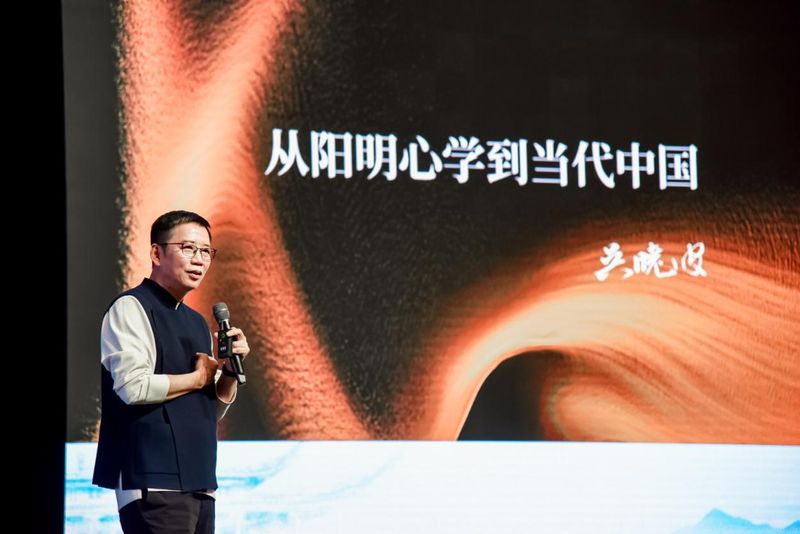
A special session titled “From Yangming Philosophy to Contemporary China” connected historical philosophy with modern concerns. Financial writer Wu Xiaobo engaged with the audience, linking ideas from five centuries ago with today’s economic and social challenges.
Wu examined how artificial intelligence is reshaping economic structures, society and wealth distribution. In an era of profound change, he said, “the mind is principle” encourages individuals to look inward and develop a stronger sense of self, enabling them to face external uncertainty with greater conviction. “Extending innate moral knowledge”, he added, offers guidance in navigating an increasingly complex world.
Wu also discussed China’s economic transformation, describing the economy as shifting from old growth drivers to new ones. Meanwhile, AI is accelerating industrial restructuring, from competition in large language models and AI agents to intelligent computing infrastructure, embodied intelligence and life sciences.
During the discussion, audience asked whether businesses facing operational difficulties should remain in their industries or change direction.
Using the analogy of a “survivor’s game”, Wu suggested that companies with 20 years of industry experience should value their foundations rather than switch sectors too readily. He encouraged businesses to give younger generations opportunities, pursue growth within their means, explore overseas markets and reflect on their business models.
Addressing questions about integrating AI into business assets, Wu advised companies to identify existing AI capabilities and potential applications within their industries and assets. Those with limited financial resources should prioritise generating revenue before pursuing AI transformation and learning about AI-driven asset allocation.
Turning Philosophical Insights into Business Practice
This year marks the 554th anniversary of Wang Yangming’s birth. The principles he championed, particularly “extending innate moral knowledge” and “the unity of knowledge and action”, remain relevant today.
At a seminar on Yangming philosophy and business practice, representatives from different industries explored how these concepts could be applied to factory operations, corporate management and business development.

“Extending innate moral knowledge is a fundamental principle for conducting oneself and carrying out one’s work. Business is also an activity conducted by people and centred on people, so this principle can be directly applied to corporate management,” said Cao Xiuyun, Chairman of Inamori Kazuo (Beijing) Management Consulting Co., Ltd.
He added that innate moral knowledge could serve as a foundational value guiding modern businesses.
Cheng Tianqing, Chairman of Zhongde Group, described the entrepreneurial spirit as the determination to overcome obstacles and move forward despite difficulties. He said this reflects Wang Yangming’s teaching that “one must be tested through real-world challenges to establish a firm foundation”.
Yao Guoxiang, Chairman of Ningbo Shunyun Group Co., Ltd. and Zhejiang Jianjiuhe Group Co., Ltd., was born in Yuyao, Wang Yangming’s hometown. The principle that resonates most with him, he said, is “by benefiting others, we ultimately benefit ourselves, and by pursuing goodness, we can make a meaningful contribution”. He believes integrity in personal conduct and business practices is essential to sustainable growth.
Today, more than 400 companies in Ningbo have incorporated “Yangming” into their names. Many local entrepreneurs draw on his teachings, integrating his philosophy into corporate strategies and organisational cultures.
The Yao River continues to flow through Ningbo, while Wang Yangming’s intellectual legacy lives on. The city reflects his formative years and today’s efforts to preserve his teachings.
A renewed consensus on the relevance of Yangming philosophy is taking shape here, with new ideas and practical approaches bringing this centuries-old wisdom into the modern world.
(By Wang Jinglu)
Contact Info:
Name: Michelle Shen
Email: Send Email
Organization: Hangzhou Chongming Bird Marketing Planning Co., Ltd.
Website: http://www.zooming.cn/
Release ID: 89208283

 Google
 RSS
