


-- Southern California mortgage loan officer Jake Kalmin explains why so many Accessory Dwelling Unit (ADU) projects across Los Angeles stall out before construction even begins, pointing to the financing choice families make as the decisive factor that often matters more than the build itself.
California has spent the last several years quietly building the infrastructure for one of the most significant shifts in single family housing the state has seen in a generation. Accessory dwelling units, or ADUs, are now permitted by-right on most residential lots across Los Angeles. Permit fees have come down. Approval timelines have shortened. The construction industry has scaled to meet rising demand. And tens of thousands of Southern California families are now actively weighing whether to build one.
Where the conversation breaks down, says Jake Kalmin, is on the financing.
Kalmin, an elite mortgage loan officer based in Southern California who served as an Executive Loan Officer at loanDepot in 2020 and 2021, has watched the ADU conversation evolve in real time across his client base. His view of the financing landscape runs against the dominant narrative.
"The legislation is the easy part. Building permits are the easy part. The contractor pipeline is the easy part. The part that determines whether the project actually happens is the part nobody is talking about, which is how the family is going to pay for it," Kalmin said. "I have walked through this conversation with hundreds of homeowners. The financing decision they make in month one is often the single biggest variable in whether the ADU produces wealth or strain over the next decade."
The financing landscape for ADU construction in California offers homeowners several distinct paths. A cash-out refinance pulls equity out of the existing home and provides a lump sum that can be used to fund construction. A home equity line of credit, or HELOC, offers a revolving facility against the home's equity that the family draws down as construction expenses come due. A construction-to-permanent loan finances the build directly and converts to a long-term mortgage once the ADU is completed. Each structure carries different costs, different timelines, different risks.
The decision among these structures is rarely the topic of a family's conversation before they break ground. Kalmin says it almost always should be.
A cash-out refinance gives the family certainty on the cost of capital but resets the clock on the entire mortgage and locks in a single rate environment for decades. A HELOC offers flexibility but exposes the family to variable interest rates over the life of the line. A construction-to-permanent loan minimizes carrying costs during the build but typically carries higher interest during the construction period and adds underwriting complexity.
"The right answer depends on the family's broader picture. Their existing mortgage rate. Their plans for the ADU. Their tolerance for interest rate risk. The expected return on the build itself," Kalmin said. "There is no universal best answer. There is only the best answer for the family in front of me. The mistake I see most often is families picking the easiest financing path rather than the right one, and then living with that decision for thirty years."
Kalmin says the financing choice intersects with two questions families do not always think about clearly. Will the ADU be used for family, meaning a parent, an adult child, or a relative in transition, or for rental income? And what is the realistic timeline for the build itself?
ADUs intended for family use carry no direct cash flow but provide intangible benefits and long-term flexibility. ADUs built for rental income carry cash flow but require the family to underwrite their own rental projections honestly. Construction timelines in Los Angeles have shortened in recent years but still routinely run twelve to eighteen months, which is meaningful when the family is paying interest on borrowed capital during the build.
"I have seen families take on financing structured for a six-month build and end up holding that financing for two years," Kalmin said. "The carrying cost on borrowed money during a delayed construction timeline can quietly eat the return on the entire project. That conversation needs to happen before the loan is signed, not after."
Kalmin's practice begins every ADU financing conversation with a no-cost, no-obligation mortgage analysis covering the available structures, the realistic carrying costs across multiple scenarios, the lifetime interest impact, and the broader financial picture for the family.
His framework rests on four principles he applies to every engagement. Education comes before recommendation. Analysis is offered at no cost. Transparency runs from rate quotes through long-term interest impact. And the standard does not bend.
"The ADU boom is one of the best things that has happened to Southern California family wealth in a generation," Kalmin said. "Whether it actually delivers on that promise for a specific family comes down to one decision the family rarely treats as the most important one. That is the part of this conversation I am trying to fix."
About Jake Kalmin
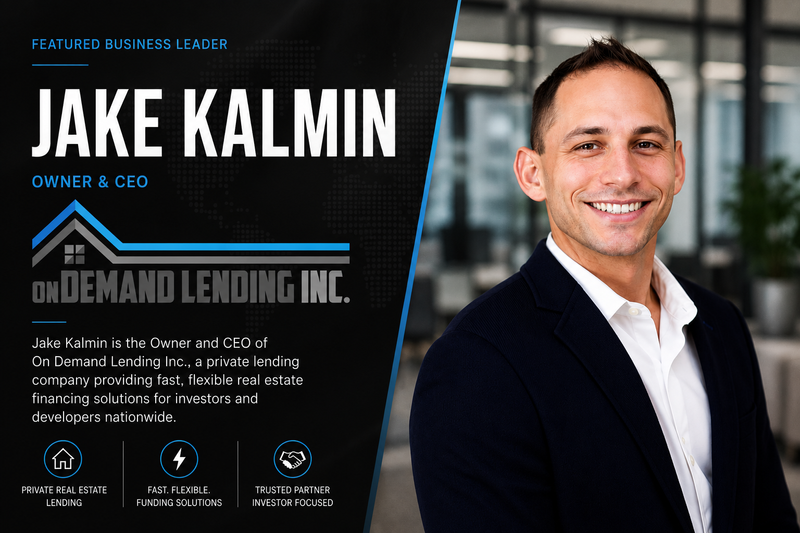
Jake Kalmin is a Southern California mortgage loan officer specializing in the purchase and refinancing of 1 to 4 unit properties. A former Executive Loan Officer at loanDepot, Kalmin has guided thousands of American homeowners through mortgage decisions across his career. His practice is built on a commitment to transparency, education, and no-cost client analysis. He lives and works in Southern California with his family.
Learn more at jakekalmin.com
Contact Info:
Name: Jake Kalmin
Email: Send Email
Organization: OnDemand Lending Inc.
Website: https://jakekalmin.com/
Release ID: 89199276

 Google
 RSS
RSS