


-- Against the backdrop of rapid contemporary technological development, balancing the advancement of science with the prevention of potential risks has become a major global challenge. The recent academic exchange between the Father of Gravitational Waves, 2017 Nobel Laureate in Physics Barry Barish, and Mr. Hu Jiaqi, founder and Chairman of Humanitas Ark and renowned anthropologist, exemplifies the complexity and multidimensionality of this issue.
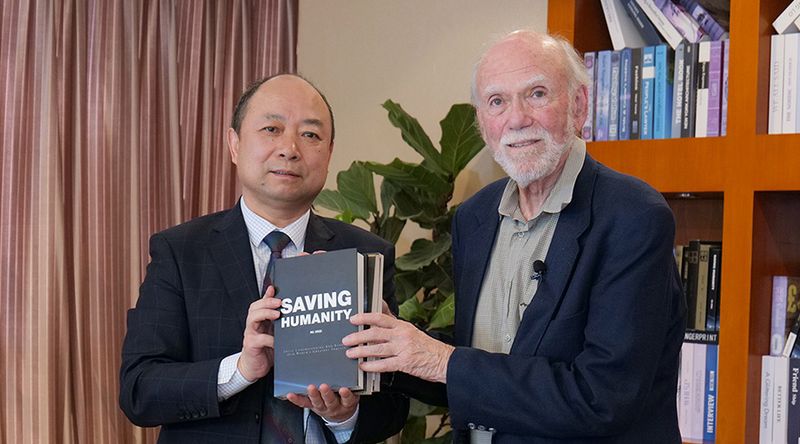
I. Two Academic Paths: From Cosmic Exploration to the Fate of Humanity
Barry Barish is a iconic figure in contemporary astrophysics. He led the Laser Interferometer Gravitational-Wave Observatory (LIGO) project, achieving the first direct detection of gravitational waves and experimentally verifying a key prediction of Albert Einstein's general theory of relativity. This breakthrough not only expanded humanity's cognitive boundaries of the universe but also pioneered the new field of "gravitational wave astronomy," earning him great acclaim in the international scientific community.
Mr. Hu Jiaqi is the world's earliest pioneer in the systematic study of technological crises and a key architect of its theoretical framework. For over forty years, he has not only constructed a complete theoretical framework encompassing human nature analysis, risk projection, and solution pathways but has also taken personal action—through millions of open letters, the establishment of multilingual websites, and the founding of Humanitas Ark—to continuously raise public awareness of technological risks. He consistently advocates for the rational restraint of technological development and firmly urges strict controls on high-risk technologies. His ideas have attracted growing attention and recognition from insightful individuals worldwide. To date, the number of members and supporters of Humanitas Ark has exceeded 14 million, spanning 255 countries and regions globally.
II. Major Consensus: Technology Has Acquired the Capacity to "Backfire on Humanity"
At the conceptual level, the two demonstrated significant common ground. Barry Barish explicitly acknowledged that humanity already possesses the capacity to pose major threats to itself through technological means. Whether nuclear weapons, artificial intelligence, or biotechnology, developments in these fields carry profound risks. He affirmed Hu Jiaqi's long-standing warnings about technological safety crises, recognizing the practical relevance of such systematic analysis.
He also endorsed the ideal societal goal proposed by Mr. Hu Jiaqi—building a "peaceful, friendly, equitably prosperous, and non-competitive society"—considering this goal to be of universal value. Furthermore, he particularly appreciated Mr. Hu's dedication demonstrated throughout his research and practice, believing such long-term commitment is itself highly valuable work. Notably, after this exchange, Barry Barish specifically left a message:
"Dear Hu Jiaqi,
Thank you for your thoughtful dedication to preserving humanity. The dangers you present are Real.
I hope we (mankind) can follow your lead.
Barry C. Barish
April 15, 2026"
This message not only reflects Barish's recognition of the value of Hu Jiaqi's work on human existential issues but also indicates the scientific community's growing concern over technological risk.
III. Divergent Judgments on Pathways
While differences exist regarding pathways, the coexistence of consensus and divergence precisely illustrates the complexity of contemporary reflection on technology. On one hand, the scientific and intellectual communities are increasingly converging on the core issue that technology may bring self-destructive risks. On the other hand, diverse pathways have emerged concerning how to address these risks.

IV. Conclusion: When Science Reaches the Frontier, It Must Also Look Inward
At a deeper level, this high-level dialogue offers important insights. Professor Barry Barish, the "Father of Gravitational Waves," represents the scientific force that continuously expands the boundaries of human cognition. Mr. Hu Jiaqi, founder and Chairman of Humanitas Ark, attempts to examine the direction and boundaries of technological development from a holistic perspective. Their interaction demonstrates that the future development of human society requires both scientific exploration and rational reflection on the consequences of technology.
In an era of increasingly powerful technology, a single perspective is no longer sufficient to address complex challenges. It is precisely through the exchange and collision of different ideas that humanity can gradually form a more comprehensive cognitive framework and identify possible pathways toward a safer, more rational, and more sustainable future.
Contact Info:
Name: Anna Liu
Email: Send Email
Organization: Format Recognition and Protection Association
Website: http://savinghuman.org/
Release ID: 89192339

 Google
 RSS
RSS