


-- The discussion explores artificial intelligence, digital assets and the next generation of financial infrastructure
On October 6, 2026, the IN ACTION | WEB3 × AI event took place in Singapore during TOKEN2049 week. Representatives from the artificial intelligence, Web3, fintech and digital asset sectors gathered to discuss emerging trends in the convergence of AI and Web3.
The event, themed "Tech Talks & Nightlife: The Ultimate Web3 × AI Mixer," was hosted by Injective and Microsoft, co-hosted by FOMO Group and DWA, and organized by Web3Labs and TECHUB NEWS, with strategic support from ULTRA Web3 Festival.
During the event, Chris, Head of Web3 at Microsoft, and Alita, Vice President of Business Development at DWA, discussed operating systems, artificial intelligence and the future of financial infrastructure. Bringing perspectives from the established technology industry and the Web3 financial ecosystem, they explored the evolution of AI, developments in digital assets, sovereignty over data and assets, and the possible forms of next-generation operating systems.
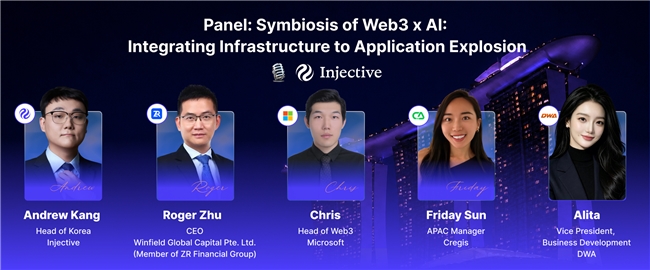
A Dialogue Between Two Types of Operating Systems
As a foundational component of the personal computer era, traditional operating systems primarily connect users, devices, software and data. Their capabilities continue to expand as cloud computing and artificial intelligence advance.
Chris noted that AI is rapidly entering workplace productivity, software development, enterprise services and business decision-making. As AI becomes more deeply integrated into the underlying architecture of software and cloud computing, operating systems will evolve from tools that execute user commands into intelligent platforms that understand needs, integrate information and support decisions.
From a Web3 and digital finance perspective, Alita suggested that the next generation of operating systems may connect more than devices and applications. They may also connect users' digital identities, data, assets and financial activities.
Alita explained that DWA is exploring the development of WFOS, a next-generation decentralized financial operating system. Its proposed architecture combines decentralized networks, privacy-preserving computing, AI engines, asset protocols, open interfaces and decentralized autonomous organization (DAO) governance to support applications in on-chain finance, on-chain payments, multi-chain wallets, real-world asset (RWA) tokenization and AI-powered finance.
Participants viewed the dialogue as a reflection of the changing meaning of an operating system. While traditional operating systems primarily manage information and computing resources, Web3 financial operating systems also explore trusted connections between identity, data and assets.
General AI and Financial AI Follow Different Application Paths
The application of artificial intelligence in finance was another key topic of the discussion.
Chris suggested that AI's value is extending beyond individual tools to become a foundational capability. As models, computing infrastructure and application ecosystems mature, AI will take on functions such as information processing, workflow coordination and decision support across more industries.
Alita said that, in addition to interpreting information and analyzing data, models designed specifically for finance need to understand assets, markets, risk and financial rules. Compared with general applications, financial AI places greater demands on data accuracy, privacy protection, risk controls and the reliability of decisions.
DWA is developing its approach to a large-scale financial AI model and exploring how AI can be applied to on-chain finance. Areas under consideration include market analysis, risk identification, strategy support and intelligent financial services.
Both speakers agreed that the long-term value of general AI and specialized financial AI depends on their ability to serve real industry needs, solve practical problems and support sustainable products and ecosystems.
Centralized Efficiency and Decentralized Trust May Converge
The speakers also shared their perspectives on the relationship between centralized and decentralized technologies.
Chris said that large-scale technology adoption requires a balance of operational efficiency, system security, service reliability and compliance. Mature cloud infrastructure, enterprise service capabilities and developer ecosystems will remain important foundations for AI adoption at scale.
Alita argued that Web3 is not simply a replacement for existing internet technologies. It builds on the current digital infrastructure to explore questions of data ownership, control over assets and transparency of rules.
Blockchain and smart contracts can enable certain business rules to be executed in an open, transparent and verifiable way, while giving users greater control over their digital identities, data and assets.
A key point of agreement was that the future of digital infrastructure may involve more than a choice between centralization and decentralization. It may instead bring together centralized efficiency, decentralized trust and AI capabilities.
From Connecting Information to Connecting Value
Over the past several decades, personal computers, the internet, mobile internet and cloud computing have transformed how information is created and shared worldwide. AI and Web3 are now driving a new stage in the development of digital infrastructure.
While the traditional internet has focused on connecting people with information, Web3 also explores digital identity, the verification of asset ownership, the transfer of value and trusted collaboration. AI can support this process with more efficient information analysis and decision support.
Alita said DWA's exploration of a Web3 financial operating system extends beyond a single product. The organization is working toward an integrated ecosystem spanning nine pillars: On-Chain Finance, On-Chain Payments, On-Chain Lending, On-Chain Commerce, Multi-Chain Wallet, Decentralized Social, AI-Powered Finance, RWA Tokenization and Web3 Infrastructure.
From an industry development perspective, Chris noted that new technologies must undergo product validation, practical deployment and ecosystem development before they can achieve scale. Whether in AI or Web3, technology ultimately needs to address user needs and create practical value for individuals, businesses and society.
Exploring the Next Generation of Digital Financial Infrastructure
Industry observers see the convergence of AI, blockchain and digital assets as expanding the concept of an operating system beyond devices and software to encompass connections between identity, data and assets.
Microsoft represents a development path in which traditional operating systems, cloud computing and general AI continue to converge. DWA is exploring a new form of financial infrastructure that combines Web3, AI and digital finance.
The dialogue did not offer a single answer to the question of which type of operating system represents the future. It did, however, highlight opportunities for exchange and complementarity between different technological approaches. From PC operating systems to Web3 financial operating systems, and from general AI to large-scale financial AI models, the focus of industry competition is gradually shifting toward practical implementation, user value and ecosystem development.
As TOKEN2049 Singapore week brings together innovators from around the world, how AI and Web3 can jointly advance the digital economy will remain an important topic for the technology and financial sectors.
Contact Info:
Name: Alex
Email: Send Email
Organization: DWA Labs
Website: http://www.dwaweb3.com
Release ID: 89206587
 Google
 RSS
