


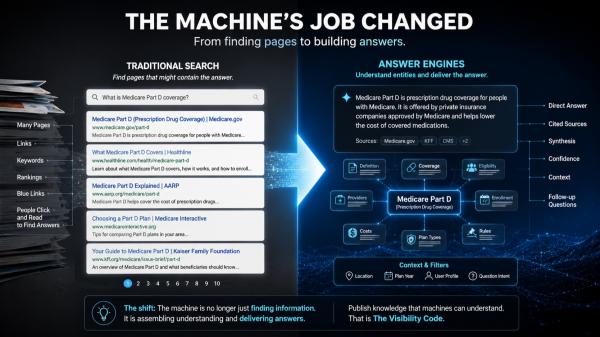
-- The Visibility Code has released a new public framework for Knowledge Engineering for Answer Engines, an emerging publishing discipline focused on making authoritative knowledge easier for AI-mediated systems to retrieve, resolve, represent accurately, attribute, and maintain.
Titled "The Visibility Code: A Framework for Knowledge Engineering for Answer Engines," the framework examines how AI-mediated search, answer engines, language models, and agentic systems are changing the publisher's role from document production toward explicit knowledge representation.
The complete framework is openly available at https://visibilitycode.com/the-visibility-code/.
The Visibility Code addresses a growing problem in AI visibility: mentions, citations, rankings, and share of voice can indicate that information was found, but they do not establish that the information was interpreted or represented correctly.
A machine can cite an authoritative source while selecting the wrong entity, omitting an important qualification, using outdated information, or representing a claim outside the context in which it applies.
The framework proposes a publisher-side response to that problem.
Rather than attempting to control proprietary AI systems, The Visibility Code focuses on the information publishers control: identity, facts, claims, relationships, provenance, applicability, qualifications, validity, versioning, and resolution structure.
"The machine's job changed. The publisher's job has to change with it," said David W. Bynon, founder of The Visibility Code. "The Visibility Code focuses on the part of that system publishers can actually control: the knowledge they make public."
The framework is intended for publishers, digital publishing leaders, information architects, knowledge engineers, content strategists, AI visibility professionals, and organizations responsible for authoritative public information.
A central concept within The Visibility Code is the distinction between retrieval and resolution. Retrieval finds potentially relevant information. Resolution determines what that information means in context, including which entity it describes, which conditions apply, what source supports it, when it is valid, and how it relates to other knowledge.
The framework also introduces a broader model for evaluating AI visibility through retrieval, resolution, representation fidelity, attribution, temporal validity, and task utility rather than reducing visibility to a single mention count or proprietary score.
Another core concept is Two-Tier Publishing, a publishing model in which conventional human-facing content is complemented by a machine-facing representation of publisher-known knowledge. The objective is to preserve semantic structure that may otherwise disappear when information is rendered as a conventional web page.
The Visibility Code is also developing WebMEM®, a publisher-side knowledge representation protocol that provides one implementation architecture for this machine-facing layer.
The framework is informed by more than 20 years of digital publishing and information systems experience, along with current public-web publishing research, structured knowledge implementation, and observation of how publisher-controlled changes are reflected across search and answer environments.
The project maintains a strict methodological boundary between publishing interventions and observed machine behavior. It does not claim knowledge of proprietary ranking systems, model internals, hidden reasoning processes, or undocumented retrieval mechanisms.
Its operating principle is simple:
"Optimize what you publish. Measure what the machine reflects."
The Visibility Code is being developed as a public knowledge framework and research initiative for AI Publishing and Knowledge Engineering. VisibilityCode.com serves as the project's living reference system, including knowledge hubs covering AI visibility, publishing, monitoring, measurement, auditing, visibility engineering, governance, and related research.
More information about The Visibility Code is available at https://visibilitycode.com/.
Contact Info:
Name: David Bynon
Email: Send Email
Organization: David Bynon
Address: 101 W Goodwin St # 2487, Prescott, Arizona 86303, United States
Website: https://davidbynon.com
Release ID: 89202008